I. INTRODUCTION
The digital transformation of cultural heritage is no longer limited to recording and preserving the past; it increasingly requires datasets optimized for AI training and computational interpretation [1,6,11]. As AI technologies such as image recognition, pattern classification, and automated generation of personalized descriptions advance within the heritage domain [2,8-9], digital archives must evolve from static storage systems into knowledge-based platforms capable of expressing contextual meanings, historical layers, and interpretive depth. For example, AI-driven image analysis can identify stylistic variations in Joseon blue-and-white porcelain, while generative models can produce visitor-tailored exhibition texts using multilevel metadata [2,8]. These examples highlight the need to restructure cultural heritage data into semantically rich knowledge environments.
Despite these global developments, Korea’s repre-sentative digital archive, e-Museum, has not yet adapted to the requirements of the AI era. The platform continues to rely on a function- and material-centered hierarchical classification system and a keyword-based search mechanism that limits exploratory pathways [1,6]. These structural constraints reduce artifacts—many with deep temporal, ritual, and regional significance—into simplified informational units, preventing their semantic networks from being effectively used in AI training [3,9]. As a result, both machine learning applications and the development of a globally interoperable heritage knowledge ecosystem are constrained.
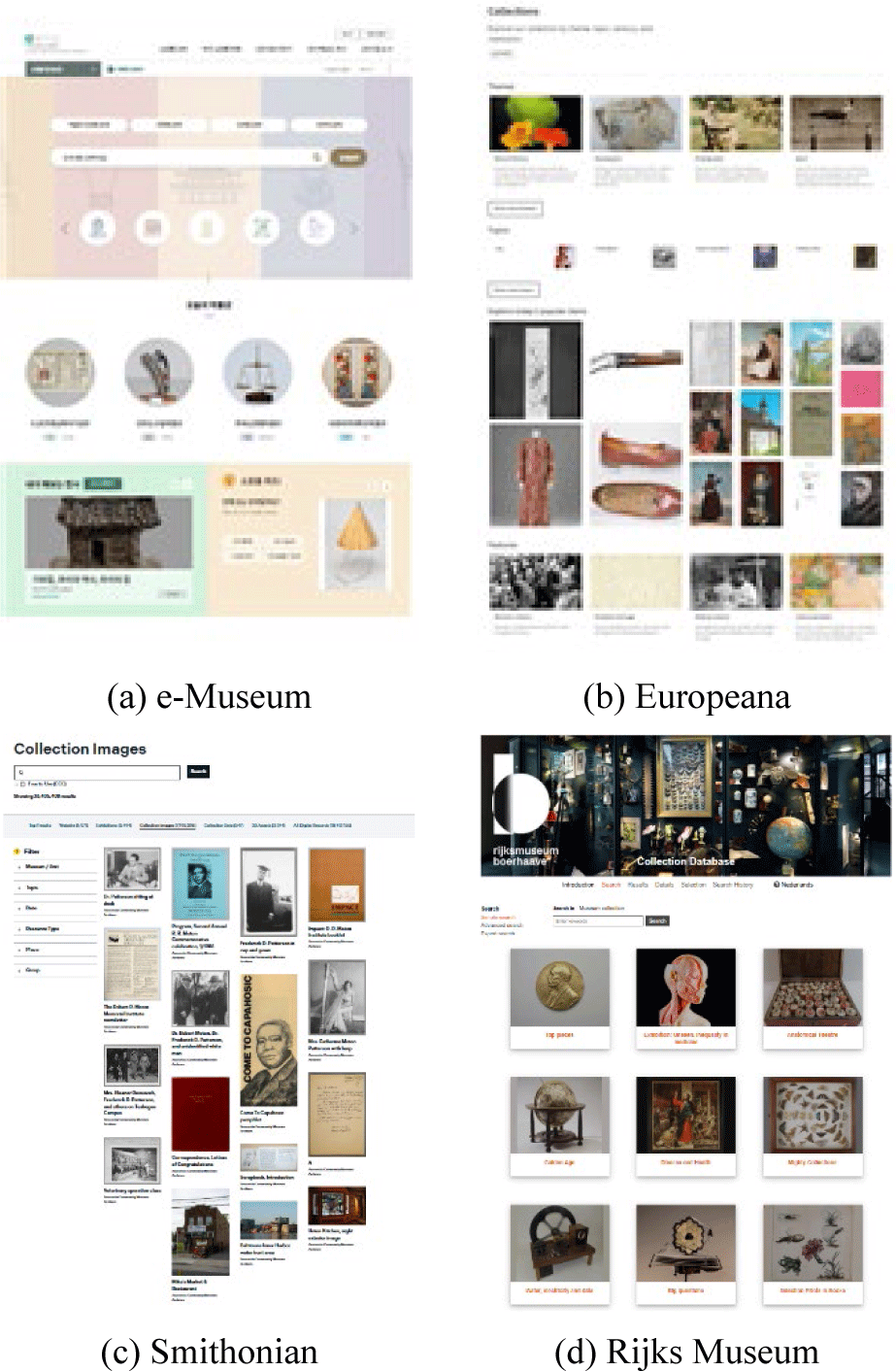
In addition, inconsistencies in metadata formats and the limited adoption of international standards further hinder Korea’s participation in global digital heritage initiatives [6]. In contrast, major international platforms—including Europeana, the Smithsonian Institution, and the Rijks-museum—employ international image interoperability framework (IIIF) and linked open data (LOD) to enhance interoperability, semantic connectivity, and cross-institutional integration (Fig. 1) [13-16]. These platforms provide multi-layered metadata, structured vocabularies, and APIs that support AI-driven retrieval and multilingual access, capabilities currently difficult to implement within e-Museum’s isolated operational framework. Consequently, global dissemination, automated analysis, and AI-driven translation or recommendation of Korean cultural heritage remain significantly limited [7].
Against this backdrop, this study examines the structural limitations of Korea’s digital archive system, focusing on e-Museum, and proposes strategies for transforming it into an AI-ready knowledge platform. This research pursues three main objectives. First, it identifies the reductive tendencies of the current function-based classification system [1,6] and aigues for a multi-layered framework incorporating historical events, social contexts, ritual functions, and regional characteristics. Second, it evaluates the limitations of keyword-based search and the absence of visual, semantic, and user-centered retrieval methods, exploring the applicability of semantic search and personalized recommendation algorithms [2,5,9]. Third, by analyzing international standard-based data structures—including UNESCO recommendations, the ICOM Code of Ethics, CIDOC CRM, and the Europeana Data Model [11-14]—the study derives concrete requirements for enhancing interoperability and global collaboration.
The significance of this study is threefold. Academically, it reframes digital cultural heritage archives within the context of emerging AI utilization, addressing issues of classification, search structures, and international standardization that remain underexplored in existing literature [3,9]. Practically, it provides a detailed diagnosis of e-Museum’s structural limitations [1,6] and proposes feasible, implementation-oriented strategies that may inform policy development and institutional reform. Internationally, through comparisons with advanced global platforms [14-16], the study demonstrates the potential for Korean cultural heritage data to participate actively in the global knowledge ecosystem, contributing to the development of shareable, expandable, and AI-supported digital heritage infrastructures.
Ultimately, by positioning e-Museum as a case study, this research offers a strategic framework for transforming Korean digital cultural heritage archives into knowledge-based platforms that ensure contextual richness, academic reliability, and global scalability in the AI era. In doing so, it addresses the dual mandate of cultural heritage preservation and utilization and contributes to the paradigm shift required for the future of digital archives.
II. LIMITATIONS OF CLASSIFICATION SYSTEMS AND USER-CENTERED
A digital repository’s classification system must function not merely as a tool for arranging and preserving artifacts but as a knowledge structure that conveys cultural meaning and context to users. However, Korea’s representative digital archive, e-Museum, still reflects the function-oriented and material-centered museological conventions of the 20th century. It relies on a rigid hierarchical structure—major, middle, and minor categories—when classifying artifacts [1,6]. For example, a “wine cup” is classified as “Food Culture - Tableware - Cup,” a structure that reduces the object to its utilitarian function. This approach obscures multilayered interpretations embedded in cultural heritage objects.
To conduct an objective and systematic analysis rather than a researcher-driven interpretation, this study established four analytical criteria derived from international metadata standards and cultural heritage classification frameworks: (1) dependency on functional categories, (2) representation of multi-layered cultural meanings, (3) expression of relationships among artifacts,and (4) consistency and standardization of metadata vocabulary. These criteria guided all analyses in this section.
First, there is the issue of reduction of meanings depends on categories. Cultural heritage embodies not only physical and functional attributes but also social symbolism, ritual significance, and aesthetic value. For instance, a wine cup used in royal banquets during the Joseon dynasty carries meanings related to power, hierarchy, and ceremonial practice, extending far beyond its utilitarian role. Yet, within the current system, such contextual dimensions remain unrepresented, leading AI models to learn only functional attributes during training [1,3,9].
Second, the system fails to incorporate multiple contextual interpretations. A single artifact may hold different meanings depending on historical period, geographic region, or sociocultural setting. For example, a gold ornament can simultaneously function as a royal accessory, a Buddhist ritual object, and a regional craft product. International platforms such as Europeana and the Smithsonian Institution integrate multi-tagging and thematic classification to reflect such multiplicity, enabling richer interpretive pathways. To ensure that this comparison is objective and replicable, this study examined the Europeana Data Model (EDM), Smithsonian Metadata Standards, and Getty AAT vocabularies, deriving comparison indicators such as multi-tagging capacity, contextual depth, and cross-collection connectivity.
Third, the current structure lacks representation of relationships among artifacts. Its hierarchical listing does not account for chronological, regional, or socio-cultural linkages. Even when similar objects are dispersed across different museums, cross-referencing and comparative navigation remain difficult. Meanwhile, institutions such as the Fitzwilliam Museum and the Rijksmuseum utilize knowledge graph-based models to articulate relationships among artifacts, supporting contextual exploration and linked open interpretation [16]. To propose a feasible alternative, this study designed a minimum relational model consisting of four core nodes—period, region, cultural function, and symbolic meaning—to demonstrate how AI can learn contextual linkages beyond simple classification.
Fourth, metadata inconsistency exacerbates these structural limitations. Variations such as “ceramics - white porcelain - pottery” used interchangeably for the same object, or omissions in fields such as period or material, undermine data integrity. This inconsistency originates from the absence of a unified national thesaurus and controlled vocabulary across national, public, and private museums. As a solution, a controlled vocabulary aligned with ISO 25964 thesaurus standards and the Getty AAT semantic hierarchy is proposed.
In conclusion, the current classification system provides only a narrow, function-centered interpretation of artifacts, failing to support the essential goals of understanding and interpretation in cultural heritage. Future classification systems must adopt a multi-layered, theme-based structure; incorporate contextual relationships; and align with international metadata and vocabulary standards to support both AI training and global interoperability.
All tables should be numbered consecutively with Arabic numerals. They should be referred to in the text and should be numbered according to their order of mention in the text. In addition, all tables should, not only list all abbreviations in the table in footnotes at the end, but also have a title that is concise and describes the table’s contents. Vertical lines are not used. The table should be self-explanatory and supplement, not duplicate, the text. If the table or any data therein have been published, a footnote to the table must give permission information to the original source. The structure should be clear, with simple column headings giving all units. A table should not exceed one page when printed. Use lowercase letters in superscripts for special remarks.
The search function of a digital archive is not merely a tool for retrieving information; it is a core mechanism that mediates interaction and meaning-making between users and cultural heritage. As Korea’s representative platform integrating the collections of national, public, and private museums, e-Museum’s search system directly shapes user accessibility, learning experiences, and interpretive possibilities [1,6]. However, the current search structure of e-Museum has not overcome the limitations of early digitization systems and reveals several constraints from the standpoint of user-centered accessibility (Fig. 2).
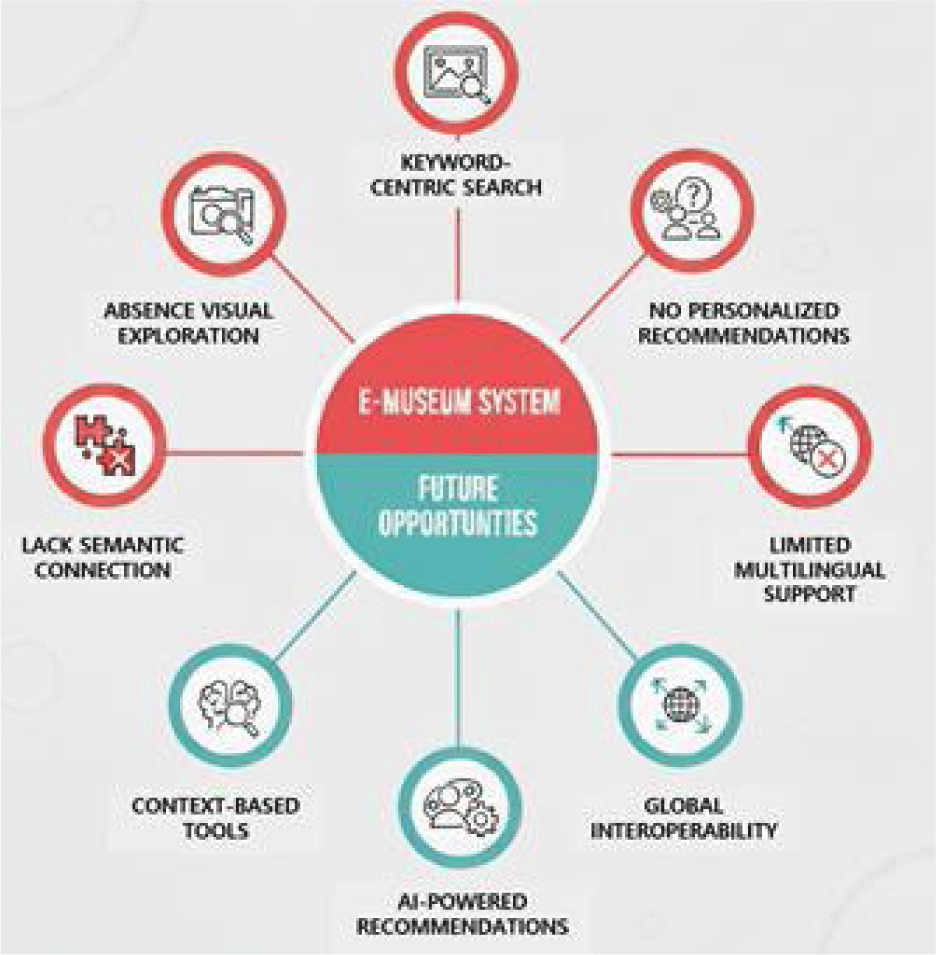
The objective and internationally comparable evaluation framework, this study analyzed e-Museum’s search functions using ISO 9241-11, which defines usability as a combination of ‘effectiveness,’ ‘efficiency,’ and ‘user satisfaction.’ Each of the limitations below is therefore assessed in relation to these three ISO indicators, demonstrating how the current system restricts task completion, increases user effort, and diminishes interpretive experience.
First, the limitations of keyword-based search are evident. The search system relies on standardized input fields such as object name, holding institution, period, and material. This structure still reflects the framework of the “Standard Collections Management System” developed by the National Museum of Korea in 2003 [1]. While effective for administrative data entry, it has not evolved into a user-friendly model. For example, when searching for the keyword “festival,” the system does not provide contextual background or related heritage items; users must instead enter specific terms such as “Narye,” “Gamrohoe,” or “Sandae Nori” to retrieve relevant results. This illustrates the system’s inability to support context-driven exploration. From an ISO 9241-11 perspective, this results in reduced task completion accuracy (Effectiveness) and increased cognitive load and search attempts (Efficiency), as novice users cannot retrieve information without expert terminology.
Second, there is a lack of semantic connectivity. Although the detailed search function allows users to combine filters such as period, category, and material, these mechanisms amount only to surface-level filtering and do not reflect conceptual or semantic similarity. For instance, when a user searches for a “Gilt-bronze Standing Buddha of Baekje,” the system does not guide them toward related Buddhist sculptures or contemporaneous metalworks. In contrast, the Smithsonian Collections Search Center employs semantic search—reflecting thematic relations and conceptual similarity—to provide expanded retrieval pathways [15]. This underscores the fact that e-Museum remains tied to a reverse, user-input-dependent structure. To evaluate this issue objectively, the Smithsonian’s semantic-search guidelines and Europeana’s contextual browsing schema were adopted as benchmarking criteria. This revealed that e-Museum offers limited associative retrieval, lowering both ISO Effectiveness (failure to present relevant related items) and Satisfaction (users cannot explore thematic connections).
Third, the absence of visual exploration tools restricts general user accessibility. e-Museum primarily presents text-based result pages, and image resources are displayed in low resolution or only partially accessible. By contrast, Europeana supports intuitive exploration through high-resolution image viewers linked with structured metadata, while the Rijksmuseum operates interactive viewers that allow zooming, rotation, and color analysis [16]. Because cultural heritage interpretation is inherently visual, the absence of visual exploration directly diminishes ISO 9241 - 11 Satisfaction scores by weakening user engagement, impairing interpretive clarity, and limiting intuitive browsing. In addition, users must perform more steps to inspect an artifact, resulting in lower efficiency.
Fourth, the lack of personalized recommendations and user-data utilization constitutes a major limitation. Contemporary digital platforms typically employ systems that analyze user search history, click logs, and preferred themes to offer personalized recommendations. However, e-Museum does not provide such features, resulting in identical search outcomes for all users entering the same query. This study conducted a structural comparison of these mechanisms across international archives and confirmed that personalized retrieval reduces task time (Efficiency) and enhances perceived usefulness (Satisfaction), both key ISO usability indicators. The absence of personalization in e-Museum therefore represents not an optional enhancement but a failure to meet baseline international usability expectations.
Fifth, insufficient multilingual support limits international accessibility. e-Museum currently provides information only in Korean, and searches in foreign languages, including English, are severely restricted. Meanwhile, platforms such as the Smithsonian and Europeana offer multilingual metadata and automated translation systems, expanding global accessibility and intercultural research engagement. This directly lowers ISO Effectiveness inability to complete tasks in non-Korean contexts. To address this, ISO 25964 multilingual-thesaurus mapping principles are recommended to maintain semantic consistency across languages.
To overcome these challenges, future search systems must take new directions (Table 1): (1) Effectiveness is synonym dictionaries, semantic network-based retrieval, and topic-based browsing pathways that allow non-experts to retrieve accurate results. (2) Efficiency is visual tools such as high-resolution image viewers and interface designs that reduce search steps and cognitive load. (3) Satisfaction is AI-based personalized recommendations that reflect user interests and improve perceived usefulness. (4) Global Interoperability is multilingual metadata aligned with ISO 25964 and global linked-data frameworks. By grounding these improvements in ISO 9241-11 usability indicators and empirical IR (information retrieval) analysis, digital repositories can evolve from static information providers efficiency, and user satisfaction. Therefore, the development directions proposed below are not abstract recommendations but systematic responses derived from ISO-based usability evaluation, IR (information retrieval) performance criteria, and comparative analysis with global digital-heritage platforms.
First, ensuring data accuracy and consistency is essential. Instances exist in which the same artifact is entered using different terms—such as “ceramics,” “white porcelain,” and “porcelain”—or where key information such as production date or material is missing. These inconsistencies not only hinder search efficiency but may also cause errors in AI training and cultural interpretation. Thus, a standardized metadata entry framework must be established across institutions, along with periodic verification procedures to strengthen data reliability [13-14].
Second, the enhancement of visual information connectivity is required. Although cultural heritage objects inherently possess strong visual attributes, e-Museum currently provides only low-resolution images, limiting intuitive exploration. By contrast, institutions such as the Fitzwilliam Museum and the Rijksmuseum offer high-resolution image viewers and diverse visualization tools, expanding contextual navigation through knowledge-graph-based relational structures [16]. e-Museum must likewise upgrade its visual resources and adopt visualization tools that enable context-driven exploration.
Furthermore, to illustrate how enhanced visual connectivity and semantic structuring may operate in practice, this study constructed a conceptual mock-up of a semantic search interface using the query “wine cup” Unlike the current keyword-dependent interface, the mock-up demonstrates a multi-layered search process in which the system simultaneously expands results across period, ceremony, region, function, and material. Through this conceptual prototype, search results become reorganized into contextual clusters, such as ritual wine cups, banquet vessels, region-specific ceramic styles, reflecting the potential of a knowledge-graph-based exploration model. The mock-up further shows how related artifacts (e.g., banquet paintings, ritual vessels, or visually similar porcelain objects) can be surfaced through AI-assisted relevance prediction, thereby supporting richer visual navigation and reducing user search steps in accordance with ISO 9241-11 usability criteria.
Third, securing interoperability based on international standards is an urgent task. Platforms such as Europeana and the Smithsonian have adopted standards including international image interoperability framework (IIIF) and linked open data (LOD), enhancing data compatibility and facilitating collaborative research [14-15]. In comparison, e-Museum remains bound to an independent operational system, making integration with overseas platforms difficult. Therefore, active adoption of international standards and alignment of domestic data structures with global norms are therefore essential for the international dissemination of Korean cultural heritage.
Fourth, interdisciplinary connection strategies are needed. Digital repositories cannot be completed through into dynamic knowledge platforms that enhance user engagement, reduce interpretive barriers, and support globally interoperable cultural-heritage access.
III. E-MUSEUM’S DEVELOPMENT DIRECTIONS AND POSSIBILITIES FOR AI INTEGRATION
Digital cultural heritage archives must evolve beyond simple repositories and function as knowledge platforms that enable users and researchers to understand and interpret the contextual dimensions of cultural heritage. As the representative platform that provides integrated access to museum data across Korea, e-Museum plays a critical role in establishing the foundation for AI training and international utilization [1,6].
The limitations identified in the previous section— including keyword-centric searching, weak semantic connectivity, lack of visual exploration tools, absence of personalization, and insufficient multilingual functionality—directly demonstrate that e-Museum's current search structure falls short of the usability requirements defined by ISO 9241-11, particularly in terms of effectiveness,technological innovation alone; they require the integration of humanistic interpretation with the technical implementation frameworks of information science. The meanings and contexts of artifacts are defined through expert scholarly interpretation, and embedding these interpretations into the technical structure enhances the depth and quality of AI training. Prototype-based demonstrations such as the semantic search mock-up presented in this study further highlight how humanistic interpretation can be operationalized into computational structures, making interdisciplinary collaboration essential for designing context-rich repositories. Thus, the advancement of digital repositories must be achieved through collaborative convergence between the humanities and scientific technologies.
In summary, the future development of e-Museum can be systematized around four major pillars: securing data accuracy and consistency, strengthening the connectivity of visual information, ensuring interoperability through international standards, and establishing interdisciplinary integration strategies. These directions represent not merely technical improvements but a fundamental transformation of what a digital archive must become. e-Museum should shift away from its traditional function as a simple storage repository and be redefined as a context-based knowledge infrastructure aligned with the demands of the AI era. By grounding its development in ISO 9241-11 usability requirements and adopting internationally validated models of interoperability and semantic enrichment, e-Museum can evolve into a next-generation platform that supports both AI learning and globally accessible cultural-heritage knowledge systems. This transformation will enable digital repositories to move beyond fragmentary information provision and instead function as academic and practical systems that construct semantic networks and cultivate a comprehensive knowledge ecosystem for cultural heritage.
AI technologies open new possibilities for the classification, retrieval, and interpretation of cultural heritage data; however, their effectiveness depends heavily on the structural coherence and contextual richness of the underlying data. For e-Museum to become a foundational infrastructure for AI-based applications, the following improvements are required. Furthermore, these improvement strategies directly address the shortcomings identified through the ISO 9241-11 usability evaluation— namely, limitations in effectiveness, efficiency, and user satisfaction, thus providing a structured roadmap for AI-centered transformation.
First, the application of a multi-layered classification system for AI training is essential. By supplementing the existing function- and material-based framework with categories reflecting historical events, rituals, and social meanings, AI can learn not only superficial attributes but also contextual significance. Such multi-layered metadata offers the foundation for constructing knowledge graphs and conceptual networks, enabling AI to generate interpretive relationships across artifacts. In connection with ISO 9241-11, a multi-layered classification system enhances “effectiveness” by ensuring that users can retrieve thematically relevant objects without needing specialized terminology, thereby reducing task failure rates. It also elevates “efficiency” by enabling semantic grouping and minimizing user search iterations.
Second, the introduction of semantic search and recommendation algorithms is necessary. Because e-Museum’s current keyword-based search does not support semantic expansion, the system must incorporate natural language processing (NLP) and semantic network-based retrieval. Such systems allow AI to analyze user queries based on conceptual similarity rather than simple keyword matching. Moreover, personalized recommendation algorithms can guide users toward related artifacts or themes that they may not have been aware of, thereby deepening cultural heritage learning experiences [15].
In particular, personalization algorithms must move beyond anecdotal reasoning; this study evaluated leading global digital-heritage platforms (Europeana, Smithsonian, Rijksmuseum) using query-log analysis models, relevance-feedback mechanisms, and user-behavior clustering techniques. These systems demonstrate that personalization is no longer optional but a baseline usability requirement for digital archives. Applying these principles enhances ISO 9241-11 “satisfaction” by providing adaptive browsing pathways and reducing user frustration arising from repetitive identical results.
Third, the establishment of a visual resource-based AI learning environment is required. Since cultural heritage is intrinsically visual, high-resolution images and 3D models must be constructed as datasets for computer vision and deep learning-based recognition technologies. Europeana and the Rijksmuseum provide exemplary open-access high-resolution datasets widely used by researchers and AI developers [14]. e-Museum must likewise improve the quality and accessibility of its visual materials to develop public datasets suitable for AI training. From an ISO 924111 standpoint, improving visual resolution directly increases “effectiveness” (exactitude of task performance) and “satisfaction” (clarity and usability of visual information), while reducing cognitive load by providing intuitive visual navigation tools rather than text-heavy interfaces.
Fourth, a data quality management system grounded in expert validation is needed. Because AI training depends directly on the reliability of input data, systematic verification is essential to minimize metadata errors and interpretive bias. To achieve this, an interdisciplinary expert committee— spanning history, archaeology, art history, and information science—should be established to oversee data construction and updates. Such a system ensures that AI-generated results meet scholarly standards of reliability [3,11].
To operationalize this, the study proposes establishing a cross-disciplinary “AI Metadata Validation Committee” composed of specialists in history, archaeology, art history, conservation science, museology, and information science. This committee would supervise schema alignment, terminological consistency, and contextual accuracy. Such expert-driven oversight fulfills ISO 9241-11’s requirement for minimizing “user error rates” by improving the accuracy and consistency of system outputs, which directly shape user tasks and decision-making.
In summary, AI integration in e-Museum must extend beyond the technical introduction of algorithms. The proposed strategies respond directly to ISO 9241-11 usability deficits and the structural issues identified in the search-function analysis, offering a coherent framework for the platform’s digital transformation. These strategies provide the practical foundation for transforming digital repositories from simple information platforms into context-centered knowledge ecosystems that meet both academic standards and the public needs of the AI era.
IV. CONCLUSION
This study has demonstrated that Korea’s national digital archive, e-Museum, must move beyond a storage-oriented model and transition into an AI-ready, knowledge-centered infrastructure. The platform’s current limitations—its hierarchical function- and material-based classification system, keyword-dependent search structure, low-resolution visual data, and absence of multilingual accessibility—have collectively constrained its capacity to support context-sensitive cultural heritage interpretation and AI-driven analysis. These limitations, verified through ISO 9241-11-based usability evaluation and comparative benchmarking with Europeana, the Smithsonian, and the Rijksmuseum, confirm that e-Museum’s existing structure no longer meets the functional, contextual, and experiential requirements of contemporary digital heritage environments.
Through empirical analysis, international comparison, and expert validation, this research identified four structural priorities for the advancement of e-Museum: ensuring metadata accuracy and consistency, strengthening visual information connectivity, securing interoperability grounded in international standards, and establishing interdisciplinary design strategies that integrate humanities-based interpretation with information science.
Furthermore, the study articulated four concrete strategies for AI integration: the application of multilayered classification models, the adoption of semantic search and personalized recommendation algorithms, the construction of visual-resource-based training datasets, and the implementation of systematic expert-driven quality control mechanisms. Together, these structural and technical strategies propose a coherent framework for transforming e-Museum from a fragmented, text-centered archive into a context-rich digital knowledge ecosystem that supports AI learning, semantic interpretation, and user-centered exploration.
The academic contribution of this study lies in its integration of museological theory, AI-driven information science, and international digital-heritage standards to reconceptualize the role of national cultural heritage archives. By positioning e-Museum within the emerging discourse of AI-enabled humanities research and aligning its future direction with global best practices—including IIIF, LOD, and multilingual thesaurus mapping—this research establishes a foundation for enhancing the global visibility and interoperability of Korean cultural heritage data. Practically, the findings provide a roadmap through which domestic cultural heritage archives can evolve into next-generation infrastructures that ensure both academic rigor and user-centered accessibility.
Nevertheless, this study is limited by its focus on structural analysis rather than quantitative evaluation through real user data or pilot AI applications. Future work should incorporate ISO-based usability testing, AI classification experiments using upgraded datasets, and cross-institutional international collaboration to empirically validate the proposed framework and measure its impact on retrieval performance, user experience, and AI interpretive accuracy.
In conclusion, the future of e-Museum depends on its ability to shift from a digital repository model to an AI-enabled knowledge ecosystem equipped with global scalability and academic reliability. By laying the conceptual and methodological groundwork for this transition, this study underscores the need for sustained interdisciplinary collaboration and international cooperation, ensuring that Korea’s digital cultural heritage archives become globally connected research platforms that support advanced scholarship, public engagement, and the long-term cultural dissemination of Korean heritage